
Finally, a Paper Airplane That Flies As Far as You Like. Every Time.
A normal paper airplane flies, then falls. This one crosses the field, turns, comes back to you, does a low pass at the fence and lands on its wheels — and when it does fall, the fall costs a sheet of paper.

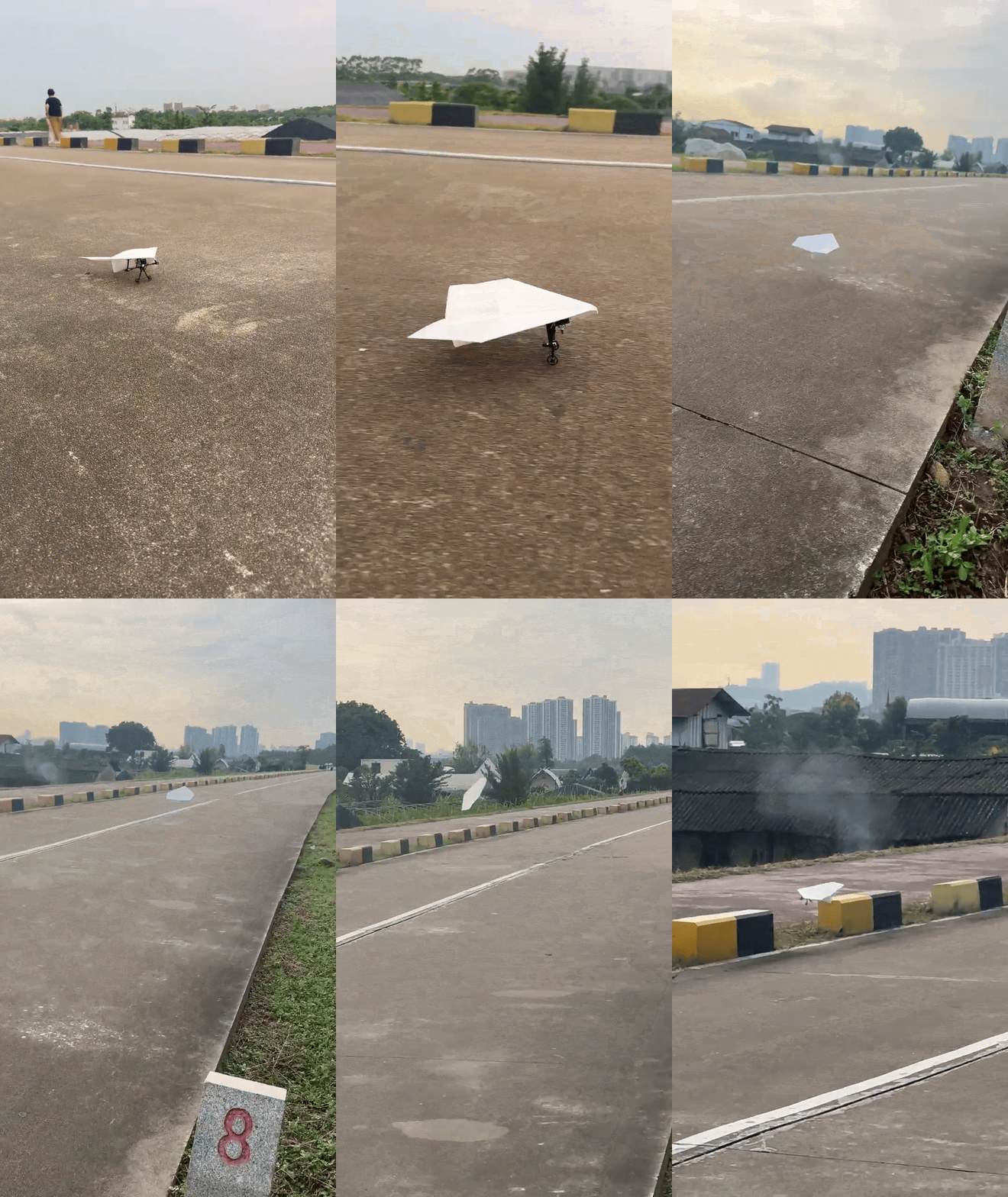


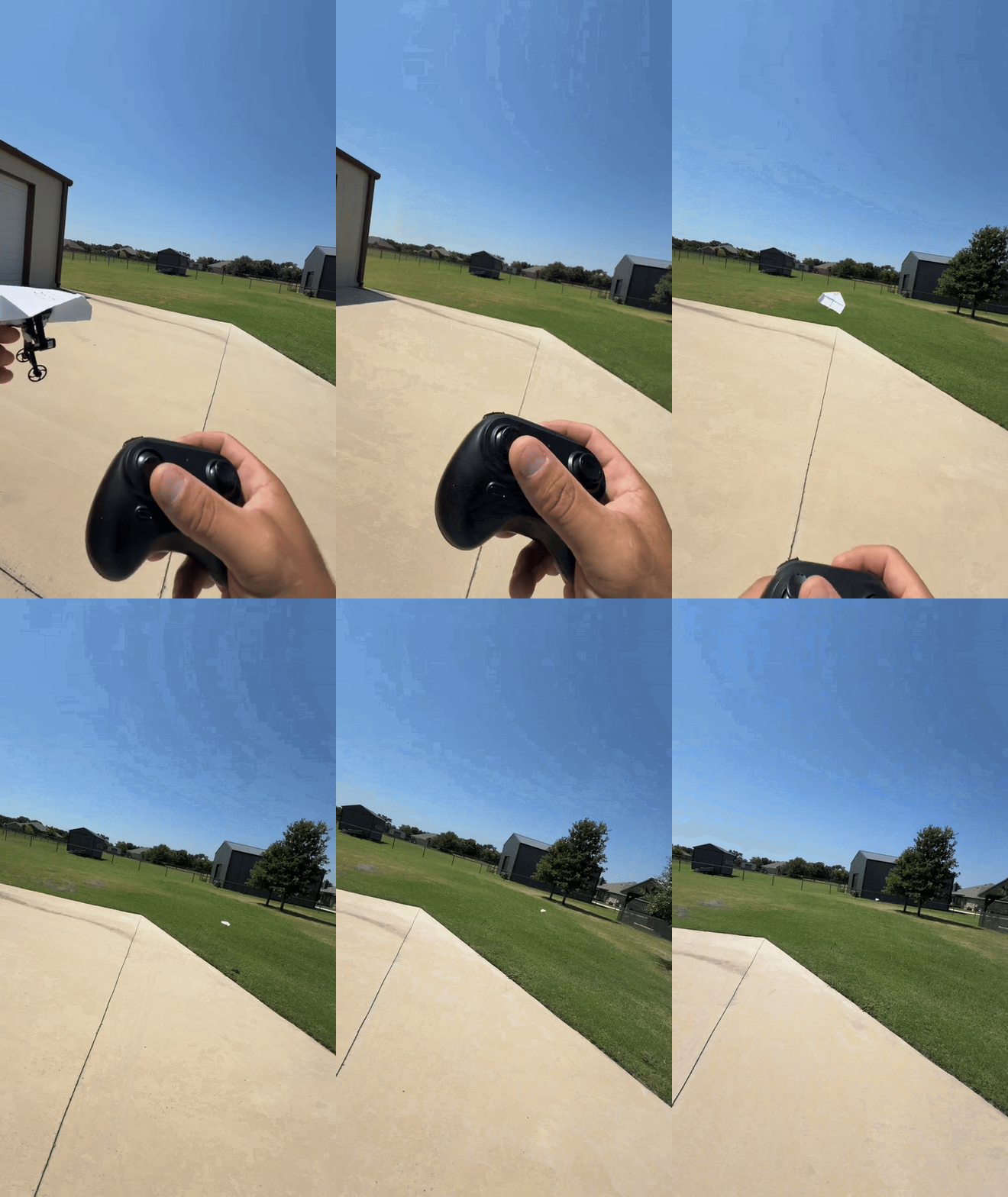


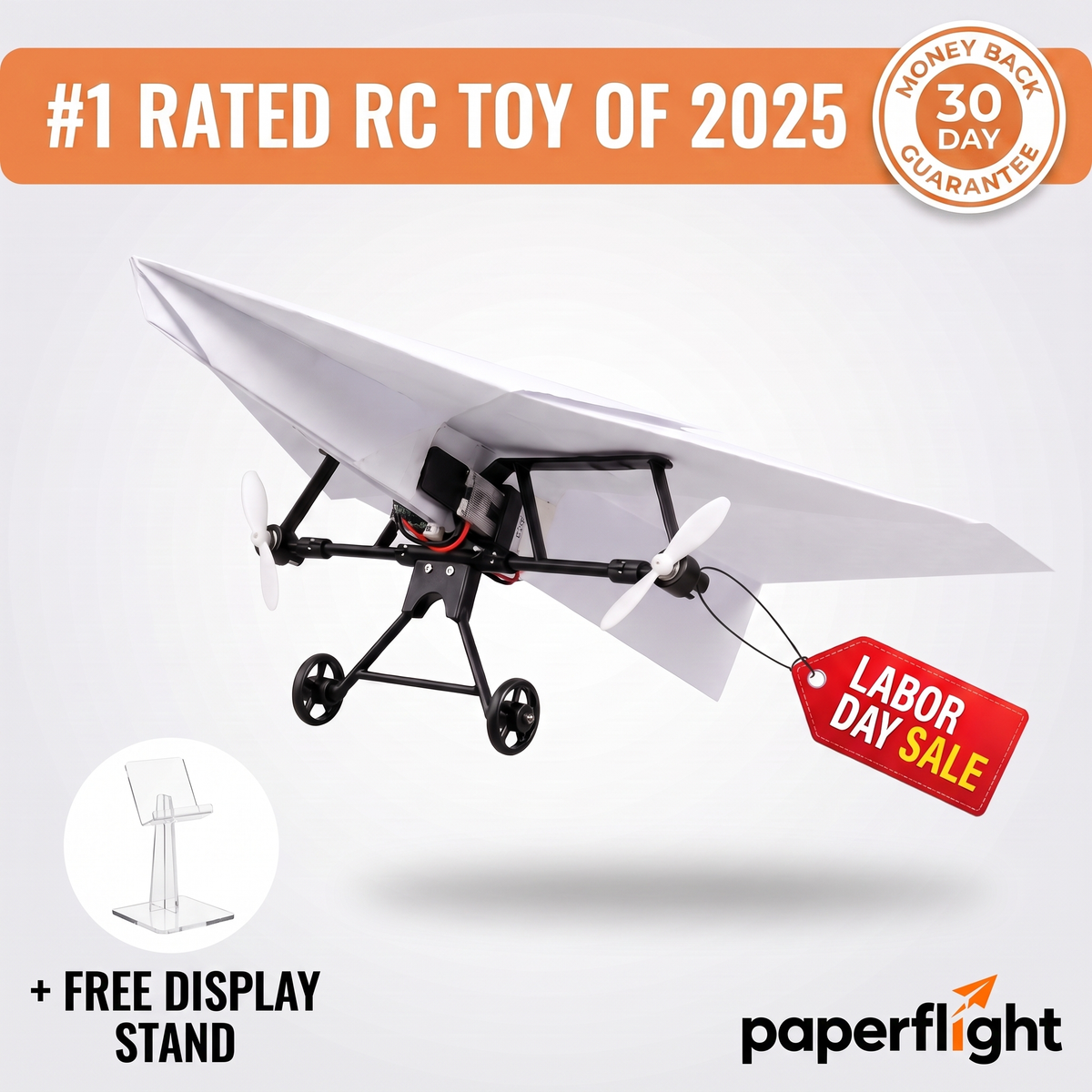
Every one of these is the same thing a kid folds out of printer paper — with the module clipped under the nose. Thrown by hand, the best arm in the house gets it about twelve feet. On the sticks it crosses the field, turns, comes back to you, skims the grass on a low pass and lands on its wheels.
A Normal Paper Airplane Flies, Then Falls. This One Flies Until You Decide It's Done.
Every paper airplane ever folded has had the same flight plan: whatever your arm gave it, a short glide, and then the ground. Throw it hard and you buy a foot or two. Throw it perfectly and you buy a second. Down a hallway that's about twelve feet, and it's over before you've dropped your arm.
The plane was never the problem. A folded sheet of paper is a real wing — it glides because the aerodynamics work. What it never had was its own thrust. So every flight was a countdown from the moment it left your hand.
Clip the motor under the nose and the countdown stops. It climbs instead of sinking. It holds height instead of bleeding it. It stays up across the whole field, comes back around, and lands where you point it — and it does that on the second sheet of paper the same as the first. The flight ends when you land it, not when gravity does.

It Comes Back. That's the Part a Thrown Plane Can Never Do.
Here's the difference that matters more than distance. A thrown plane goes away. Every flight ends with a walk to wherever it landed — the neighbour's hedge, the roof, the far side of the field. Half of "flying a paper airplane" has always been retrieving it.
This one turns. Push the right stick and it banks, comes around in a wide arc, and flies back toward you. Push again and it straightens out. It'll fly a circuit of the field and come home. Under the nose sit two propellers on a crossbar, and to turn, the module spins one faster than the other — no rudder, no moving parts on the tail, nothing to snap. A gyro inside holds the wings level between your inputs so a sheet of paper tracks straight instead of rolling over.
So a flight isn't out-and-fetch anymore. It's out, around, back, around again, and a landing in the grass in front of you. The only thing you walk to is the one you crashed on purpose.
How Far? As Far as You Can See It and Still Steer It.
People ask for a number, and the honest answer is that the plane isn't the limit anymore. Your arm was the limit. Now it's your eyesight and the battery. A thrown plane is done in a second and a half; this one will cross a school field, climb well past roof height, and keep going until it's small enough that you'd rather turn it around than lose sight of it.
The flight lasts as long as the charge does, and the whole point of the design is that you don't spend that charge chasing it. You spend it flying: out to the far fence, a wide turn, back overhead, out again. A single battery is a proper session — not one throw and a walk.
And distance stacks with the fold. A wide, flat glider on low throttle will float across the whole field on almost nothing. A narrow dart on full throttle covers the same ground fast and climbs while it does it. Same motor, same remote — the airframe decides the range, and the airframe is whatever he folds next.

It Does Things a Paper Airplane Has No Business Doing. And Some It Won't.
Once he's got the sticks figured out, this is where it goes. Low passes — skimming the grass at knee height across the whole yard and pulling up at the fence. Touch-and-goes — wheels brush the driveway, throttle back up, and it's climbing again without stopping. Rolling takeoffs from a standing start on concrete, which no thrown plane has ever done. Steep climbs on full throttle until it's a dot, then throttle off and a long, slow glide back down.
Loops depend on the fold. Some designs will pitch up into one on full power with a bit of up-curl on the wing's back edge; most won't, and he'll find out which by trying. That's half the fun and it costs a sheet of paper per experiment. What it won't do is a clean barrel roll — there's no aileron to roll with, and we'd rather tell you than have you find out. It reacts with a beat of delay and then banks decisively, so you tap the stick rather than hold it. Everyone overcorrects for the first battery, and then it clicks.
None of this is in a manual. He works it out by flying it, crashing it, folding a different one, and flying that. By week two there are six planes on the table with numbers penciled on the wings and a running argument about which one loops.
When It Does Fall, the Fall Costs a Sheet of Paper.
It will crash. Constantly. Into the fence, the hedge, the driveway, the one tree in the field. That's not the warning — that's the mechanism. The airframe is the disposable part. The paper crumples, he unclips the motor, folds a fresh sheet, clips it back on, and he's in the air again in about ninety seconds. The motor, the gyro and the remote are what you keep, and they're built to take the landing on the wheels.
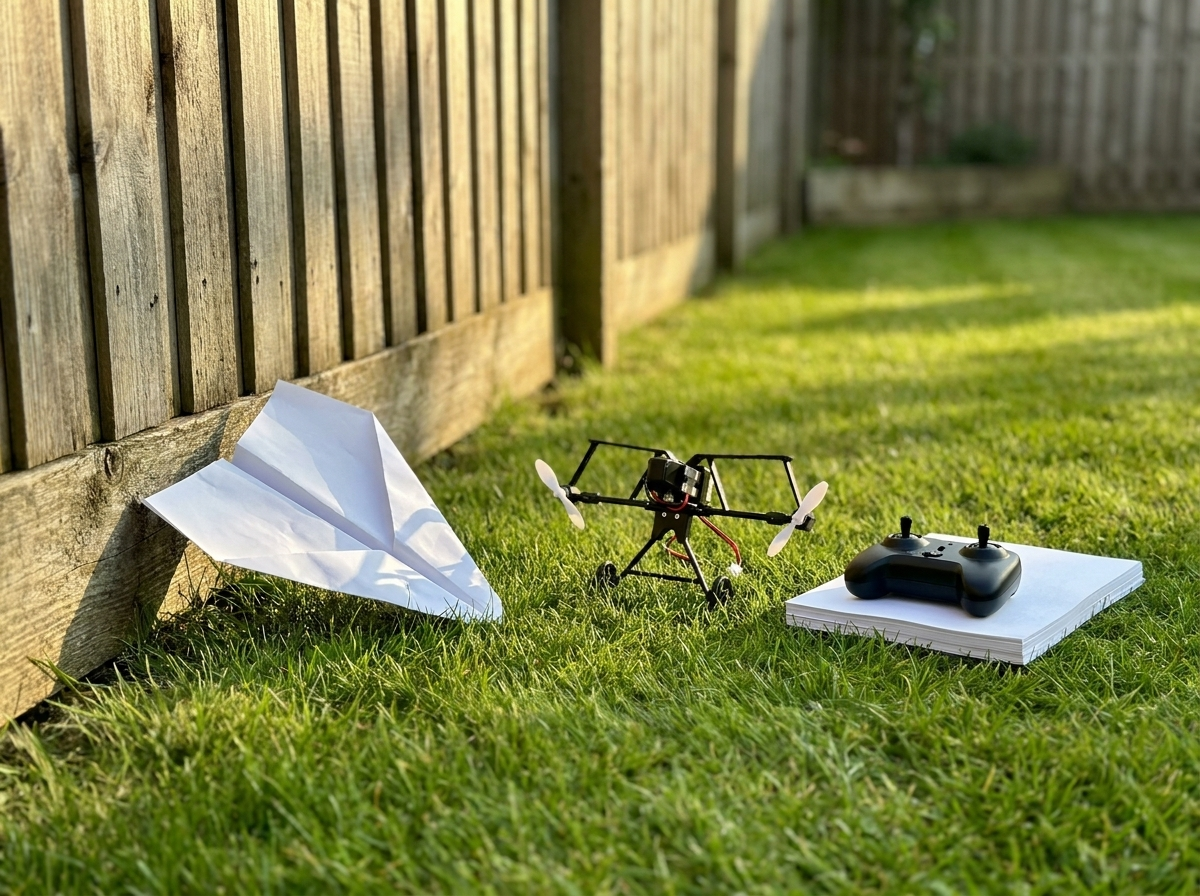
One kit is $44.95 in the Black Friday Sale, down from $80.00 — the twin-prop module, the two-stick remote, a rechargeable battery, USB cable, detachable landing gear with wheels, a small screwdriver, a display stand and the manual. No paper: he folds his own from the printer drawer, and a ream is about 500 airframes.
Two kits are $64.95 — the second one is half price, $32.48 each. Five are $109.95 and a sixth comes free, which is $18.33 a kit. Two in the air at the same time is a different afternoon entirely: two planes doing circuits, two low passes at the fence, and an argument about whose fold flies further.
The build, the fold, the module going on, the takeoff and the landings — crashes included. Nothing here was filmed by us.
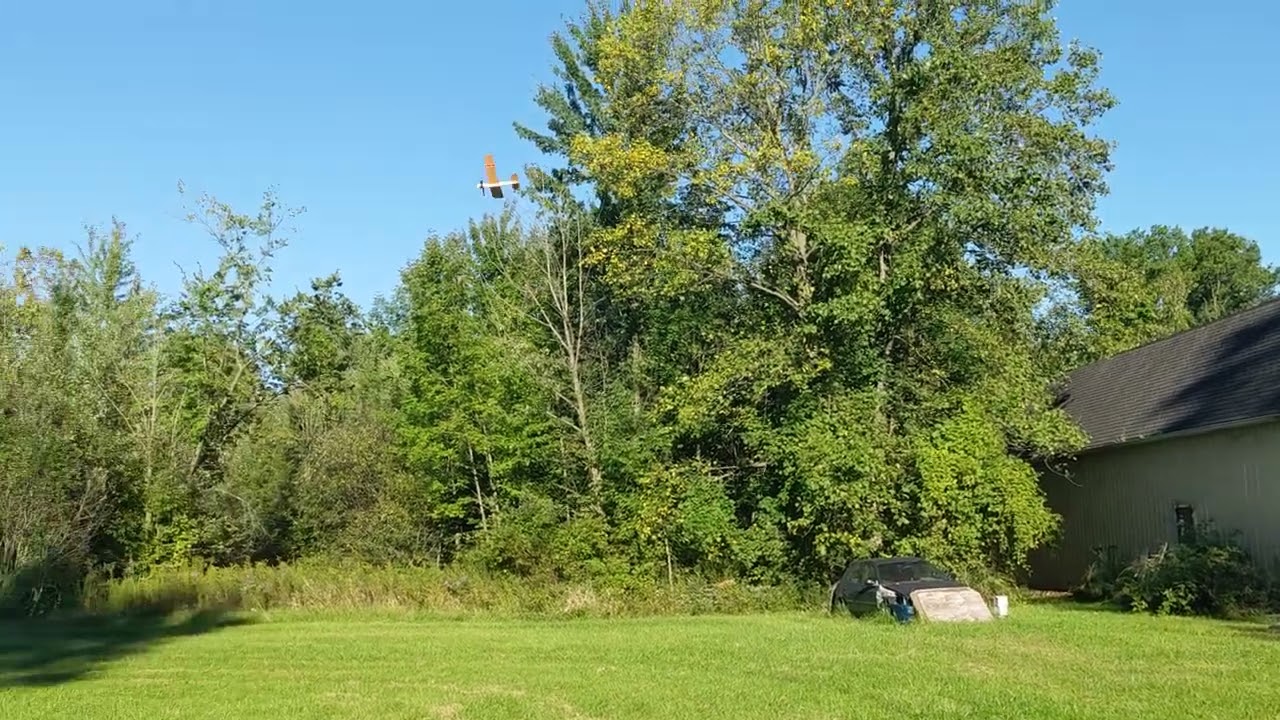 Customer Video
Watch it come back. The turns, the return, the landings — and what happens on the ones that don't land.
A twin-propeller power module with a gyro that clips under the nose of any paper plane he folds — flown on a real two-stick remote. Steers by thrust, so there's no rudder and nothing to snap. The paper takes the crash.
Why the sale runs in September. Every kit that ships now is one we're not racing to deliver in the December crush. Early shoppers get the price. When the holiday rush starts it goes back up — that's the whole story.
Those are reviews of the app-controlled kit — the one you fly by tilting a phone. PaperFlight gives you the same flight — a plane you folded, climbing and turning — on two real sticks instead of glass, with nothing to reorder when it hits the ground.
One kit $44.95. Two for $64.95 — the second is half price. Five for $109.95 and the sixth is free. Free shipping on the whole order and 30 days to change your mind.
Get PaperFlight — Pick Your Number →