
Every Drone You Bought Him Died on Impact. This One Is Built to Crash.
Five reasons dads who've buried a drawer full of drones are handing their kids a paper airplane with a motor on it — and telling them to crash it on purpose.
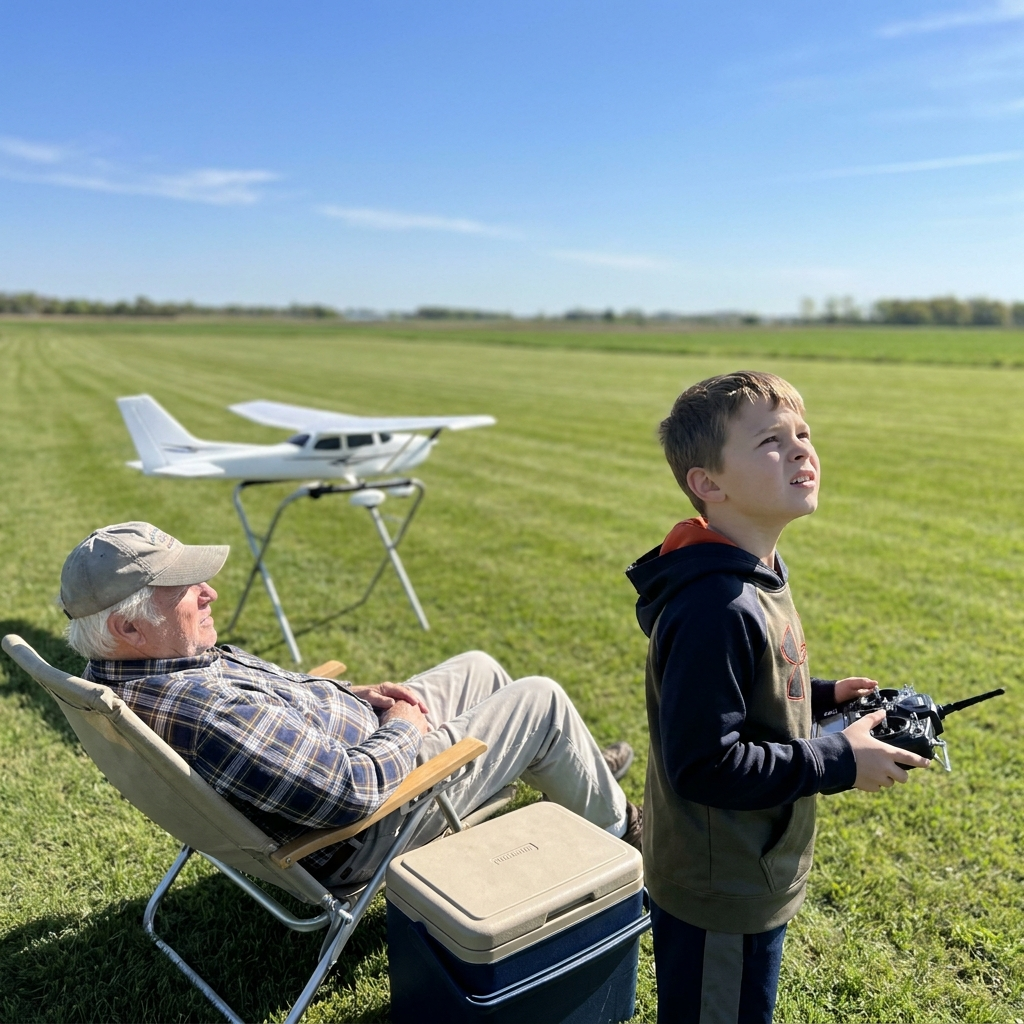
Your Drones Didn't Die From Bad Luck. They Died Because the Crash Hit the Expensive Part.
You've got the drawer. Snapped prop arms, a cracked shell, a motor that stopped spinning after the fence. The “crash-resistant” one with the cage died too — the cage lived, the motor under it didn't. Add it up and it's a couple hundred dollars for about forty minutes of your kid actually flying.
Lay them out like an outage report and the pattern is obvious: every one of them was built so the part that hits the ground is the part that costs money. Prop arms, motors, the body with the board in it. Buying tougher never fixes that. It just means the expensive part survives a slightly harder crash, and a ten-year-old will always find the harder crash.
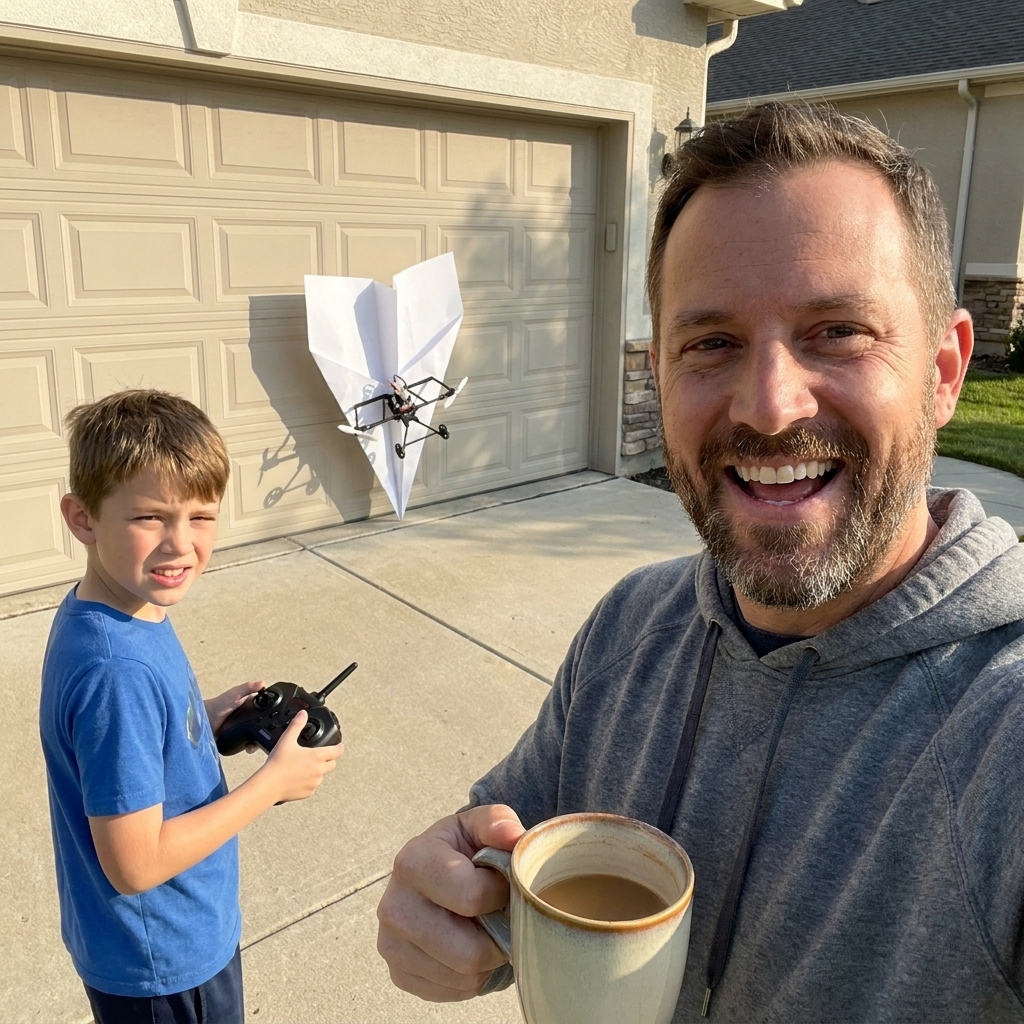
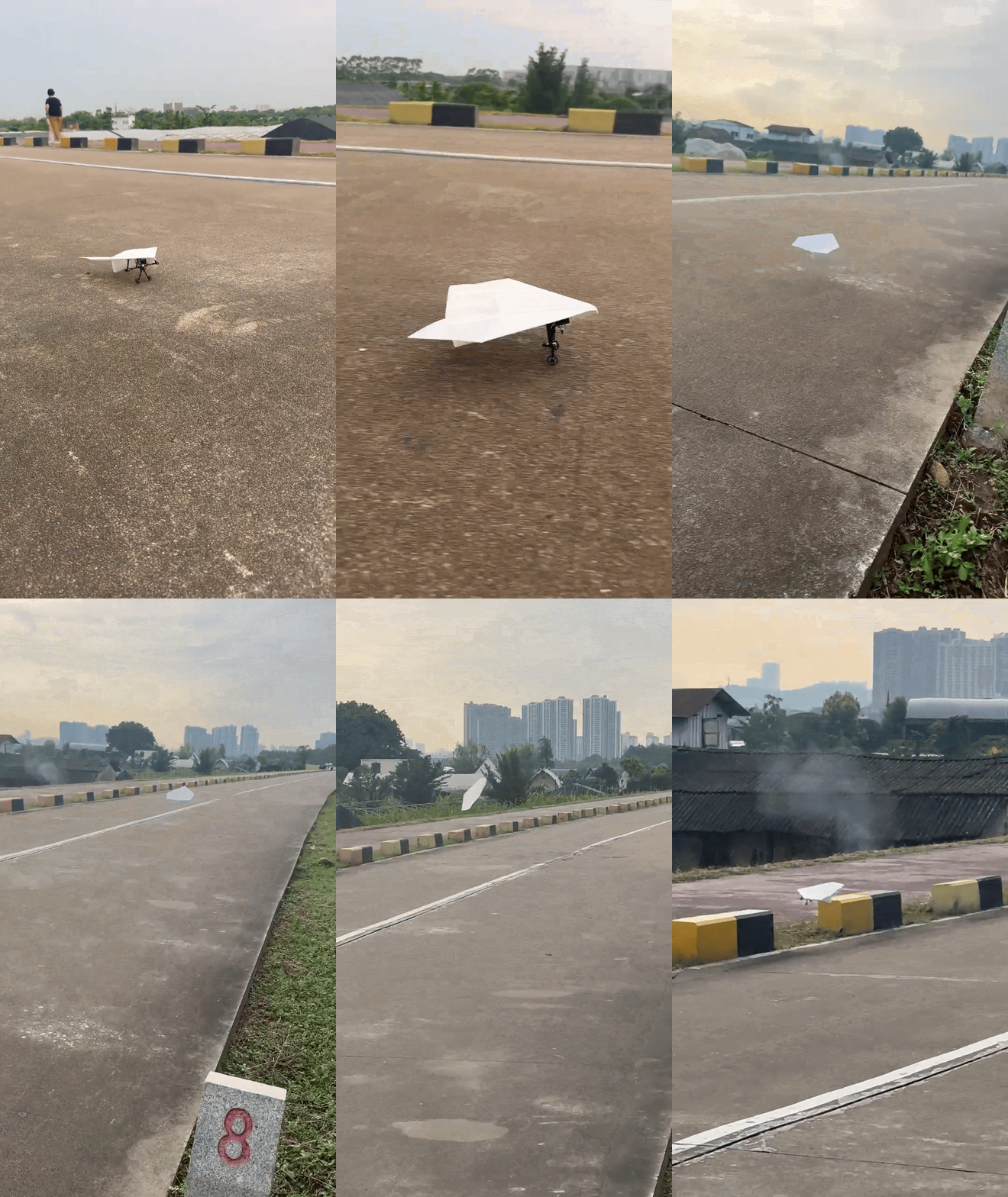
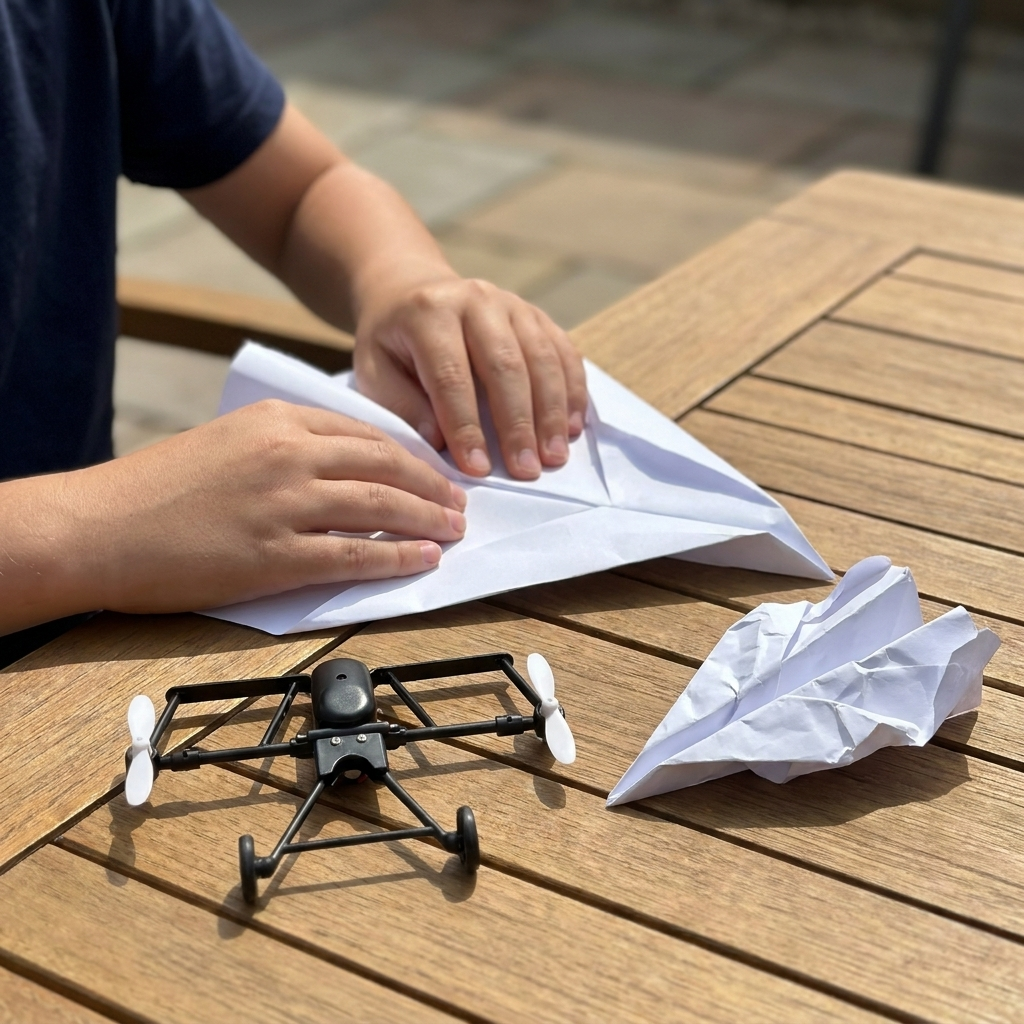
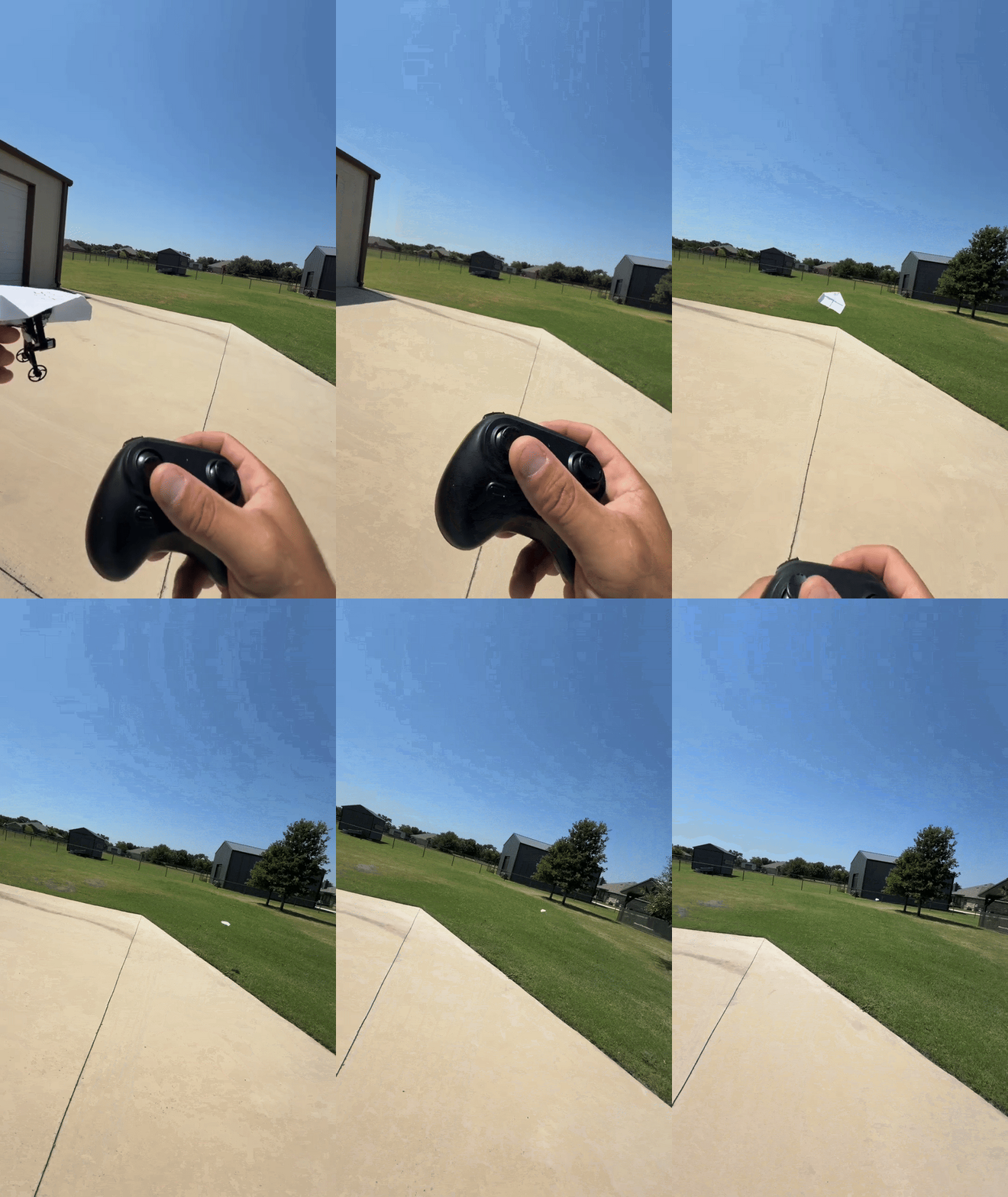
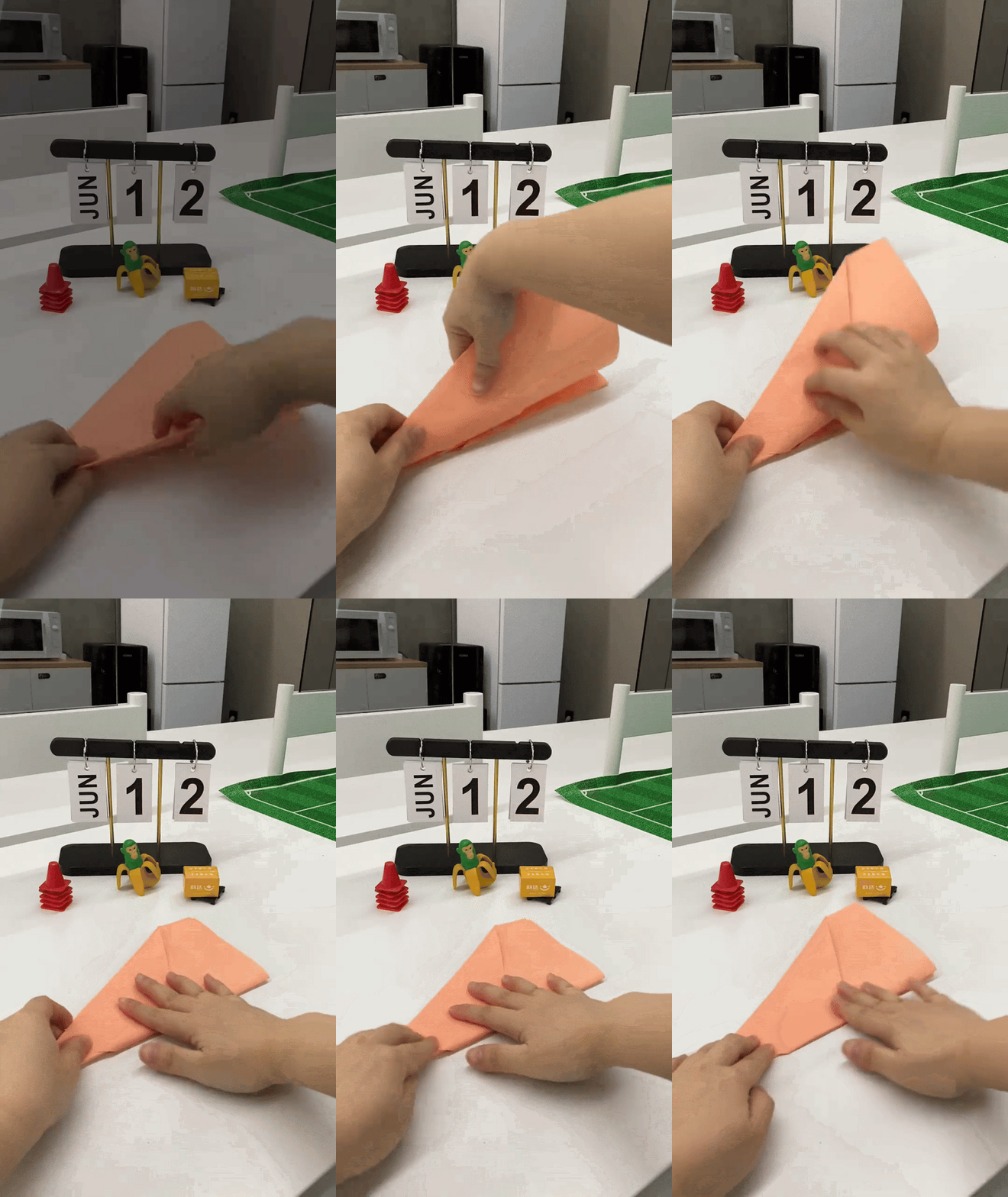
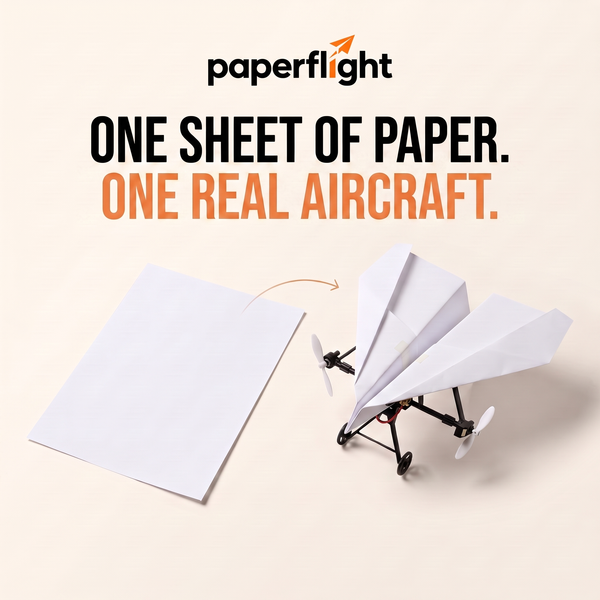
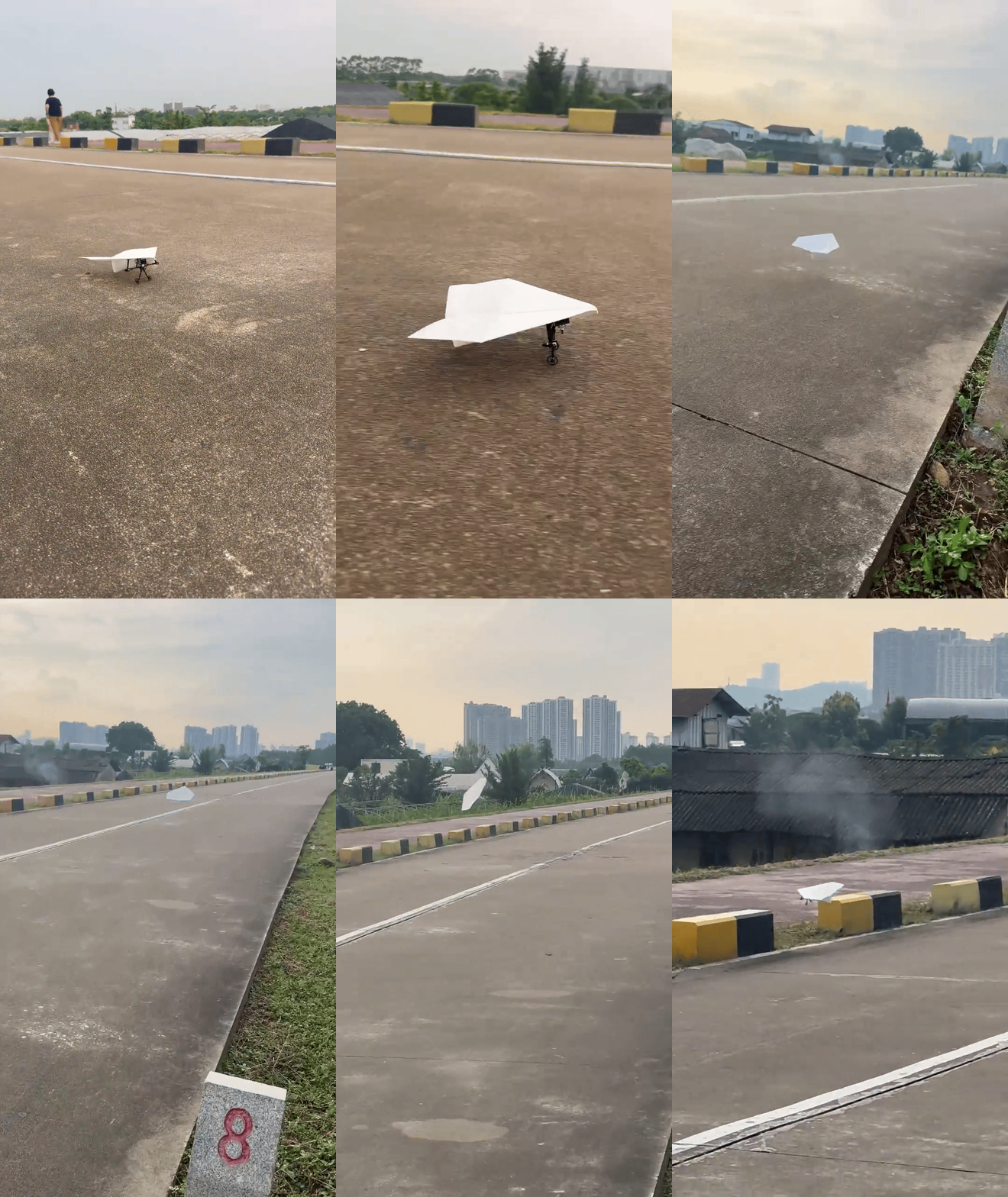
PaperFlight moves the crash. A small twin-prop module clips under the nose of a paper airplane he folds himself. The paper is the crumple zone. When it goes into the fence, the nose crumples, the module comes off, he folds a new sheet and he's flying again. The motor and remote never pay for the crash.
Two Props Up Front. No Rudder. Nothing on the Tail to Snap.
If you've ever glued a rudder hinge back on at 9pm, you already know where cheap RC planes die: the steering. Little control surfaces hanging off the tail, driven by linkages and servo gears the size of a fingernail, on a plane that's going to land nose-first. The most fragile system on the airframe takes the most stress in every crash.
This one doesn't have any of it. A crossbar across the nose carries a prop at each end, both pulling forward. To turn, the module spins one faster than the other. No rudder, no elevator, no servo, no pushrod. An onboard gyro reads the wings and helps hold them level between inputs, so a paper plane that wants to roll off and dive flies straight instead.
The rechargeable battery charges from any USB port. Landing gear clips on underneath for rolling takeoffs off the driveway; pull it and hand-launch.
Real Pilots Use Sticks. Not a Phone Taped to a Paper Plane.
The famous paper plane kit flies off your phone. Pair it, update the app, tilt the glass to steer. You probably watched your kid try it: thumb sliding around, the plane lurching, and two minutes later he's handing you the phone like it's homework. Then the Bluetooth drops halfway across the yard and the plane just lands.
That was never a patience problem. Glass can't talk back. There's no travel, no center, nothing to push against, so he can't feel how much he asked for and can't correct it. Put the same kid on a game controller and he'll focus for three hours.
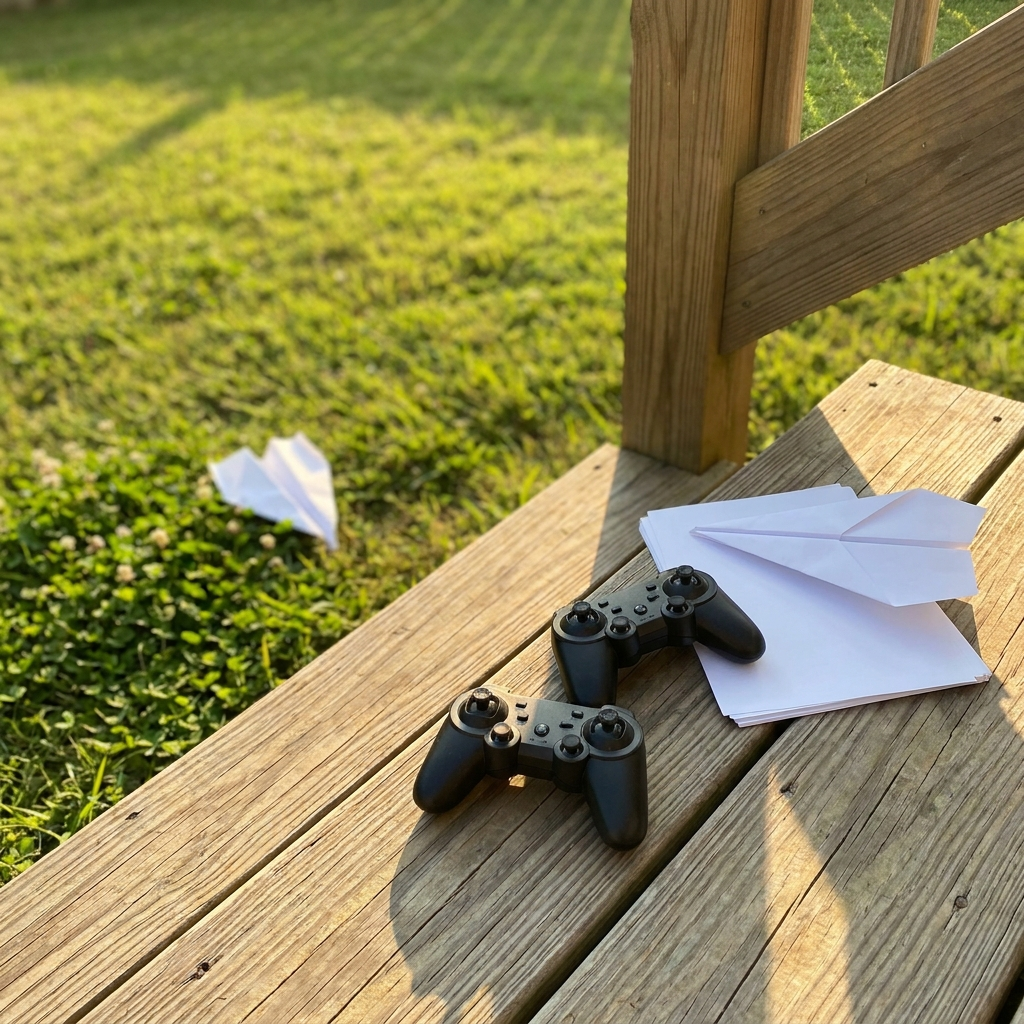
PaperFlight ships with a real two-stick controller in the box. Throttle on the left, steering on the right. It isn't a hobby-grade transmitter — it's a compact two-stick unit — but it's the layout his thumbs already know. No app, no pairing, no account. Turn it on and fly.
“Careful” Was Never a Flying Lesson. First Rule Now: Crash It.
Be honest about what happened with the drones. You started hovering. Hand half out every time it dipped. “Careful near the tree.” “Give me that, let me land it.” You weren't teaching him to fly. You were protecting sixty bucks — and he felt it. Flying turned into a test he kept failing in front of you, and at some point he started saying “that's okay” when you offered to take him out.
Every pilot learns the same way: by crashing, a lot. When the crash costs a sheet of paper, “careful” disappears on its own. Tell him to fly it into the garage door on purpose. Watch his face when you laugh instead of flinch.
And somewhere around the fifteenth crash, something shifts. Crashing on purpose turns into landing on purpose, then into threading it between the hedge and the fence. That's what happens when a kid stops being scared of the ground.
$31.95. Less Than the Drone That's in Your Gutter.
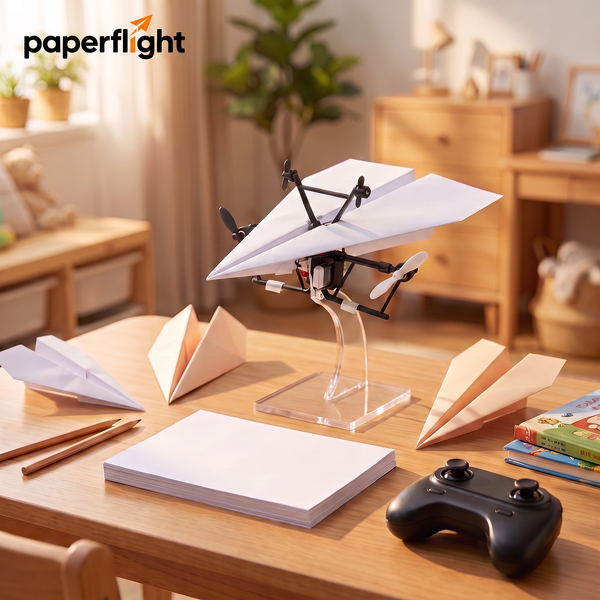
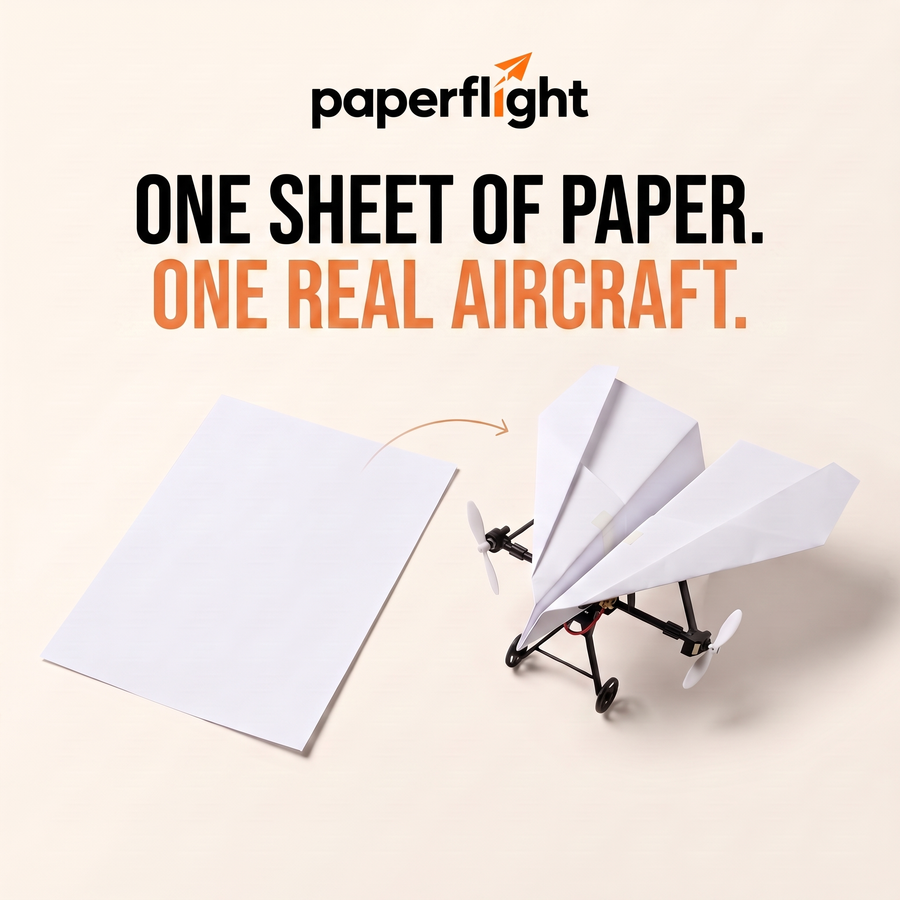
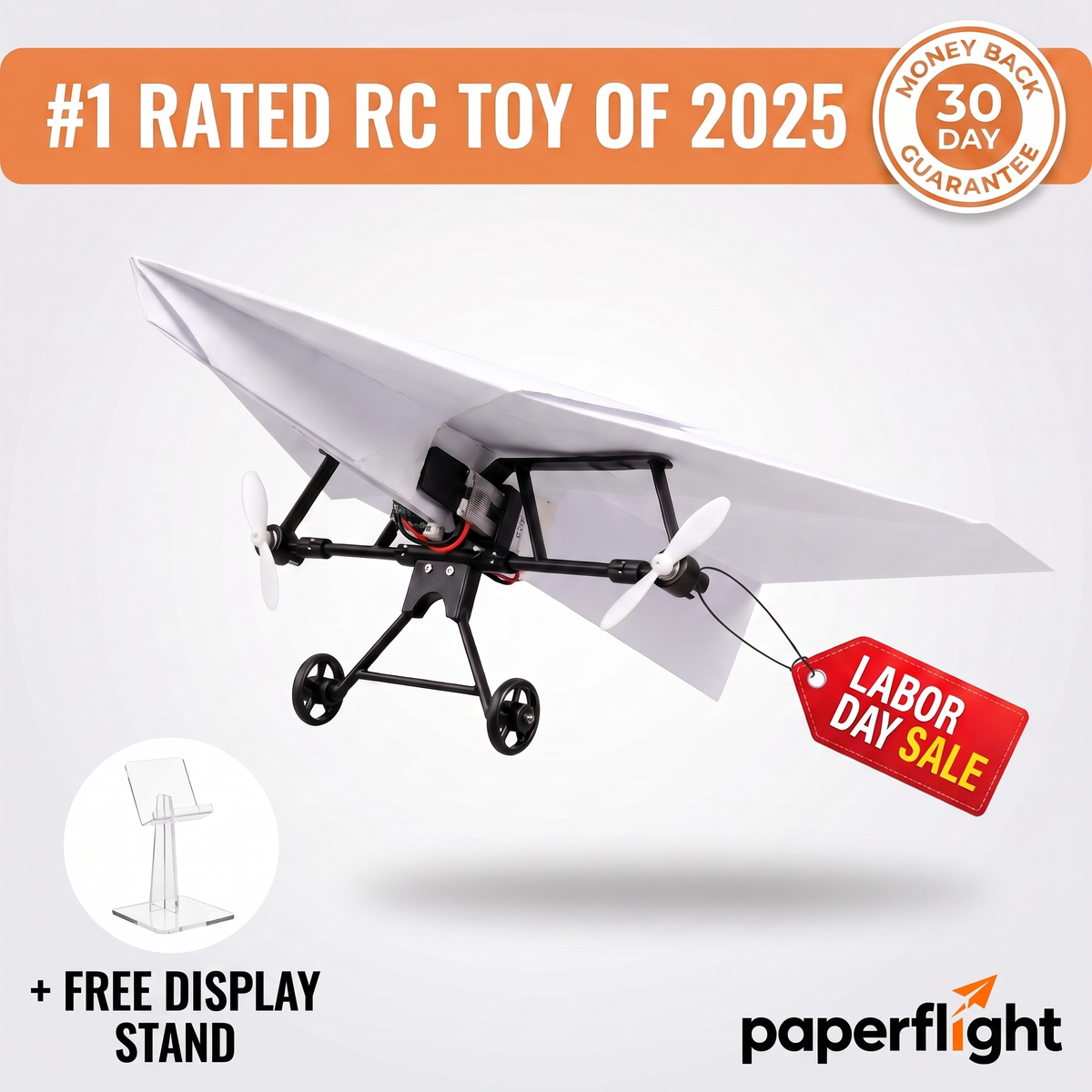
PaperFlight is $31.95 during the Early Fall Sale, half off with free shipping. That's the twin-prop module, the two-stick remote, a rechargeable battery, USB charging cable, detachable landing gear with wheels, a small screwdriver, a display stand, and the manual. The airframe is a sheet from the printer. You've got about 500 in a ream.
Get two. Two kits are $54.95 — one for him, one for you. You've wanted RC since you were a kid, and at $300 a crash you'd never have let him touch the sticks. At a sheet of paper a crash, you can both fly.
The honest limits, because you'll find them anyway: it's a toy module, not hobby-grade gear, and it won't do what a four-channel plane does. It needs open space. It won't fly in real wind. The battery is short, so charge it while he folds the next one. The props are the one part that isn't paper. And it wrecks planes constantly, which is the entire point.
A twin-propeller power module with a gyro that clips under the nose of any paper plane your kid folds — flown with a real two-stick remote. No rudder, no servos, no app. The paper takes the crash. Fold another, fly again.
Why 50% off in September? Every kit that ships now is one we're not racing to deliver in the December crush. Early shoppers get the price. When the holiday rush starts, it goes back up — that's the whole story.
$31.95 during the Early Fall Sale — half off, free shipping, and 30 days to change your mind. Two real sticks, no rudder to rip off, and a crash that costs nothing. Tell him the first rule.
Get PaperFlight — 50% Off →