Your RC Plane Doesn't Have a Battery Problem. It Has a Weight Problem.
Five reasons the foam trainer is dead in the grass by minute five while the plane made of printer paper is still up at the hour — on a battery the size of a matchbox. Once you see what the motor is lifting, you can't unsee it.




Open Up a Foam RC Plane and Count What the Battery Is Lifting.
You know the moment. Minute four, maybe five. The plane goes soft in a turn, the nose drops, and it settles into the tall grass by the fence. The battery's done. And the fix everyone reaches for is the same: a bigger battery, a second battery, a faster charger. None of it works, because the battery was never the problem.
Here's what a foam RC plane makes its motor carry into the air on every single flight:
- Foam fuselage, wings and tail
- Three or four servos to move the control surfaces
- An ESC (the speed controller) and a receiver
- Pushrods, control horns, hinges
- A rudder and an elevator
- Landing gear that isn't paper
- A brick of a battery big enough to lift all of the above
- One twin-prop motor frame with a gyro
- One small battery
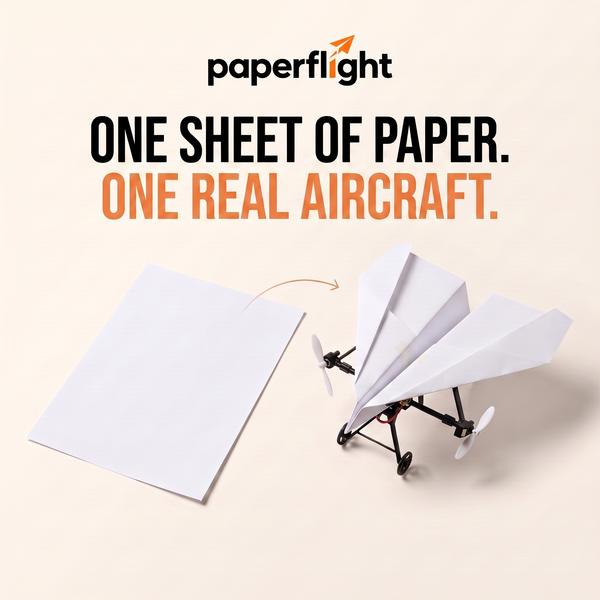
- One sheet of printer paper
Every one of those parts is dead weight to the wing. The motor doesn't know what it's lifting. It only knows how heavy it is, and it burns the battery to match.

Double the Weight, and the Motor Needs Almost Three Times the Power.
This is the part nobody puts on the box. To stay level, a plane has to make lift equal to its weight. A heavier plane needs more airspeed to make that lift, more airspeed means more drag, and more drag means more thrust, which means more current out of the battery every second it's up.
Aircraft engineers size motors with a rule of thumb: the power a plane needs in level flight rises roughly with its weight to the power of 1.5. Double the weight and you need about 2.8 times the power. Not double. Almost triple. That's why "minute five" shows up on every foam trainer no matter which battery you buy for it.
And here's the trap: a bigger battery is also a heavier battery. You add it to buy minutes, the plane gets heavier, the motor works harder, and most of the new capacity goes into lifting the battery itself. Foam RC is stuck in that loop. Paper isn't in it. A sheet of printer paper weighs about five grams. Weigh a small foam trainer with its battery and you're holding the equivalent of a thick stack of them.

The Airframe Is One Sheet of Paper. The Motor Only Lifts Itself.
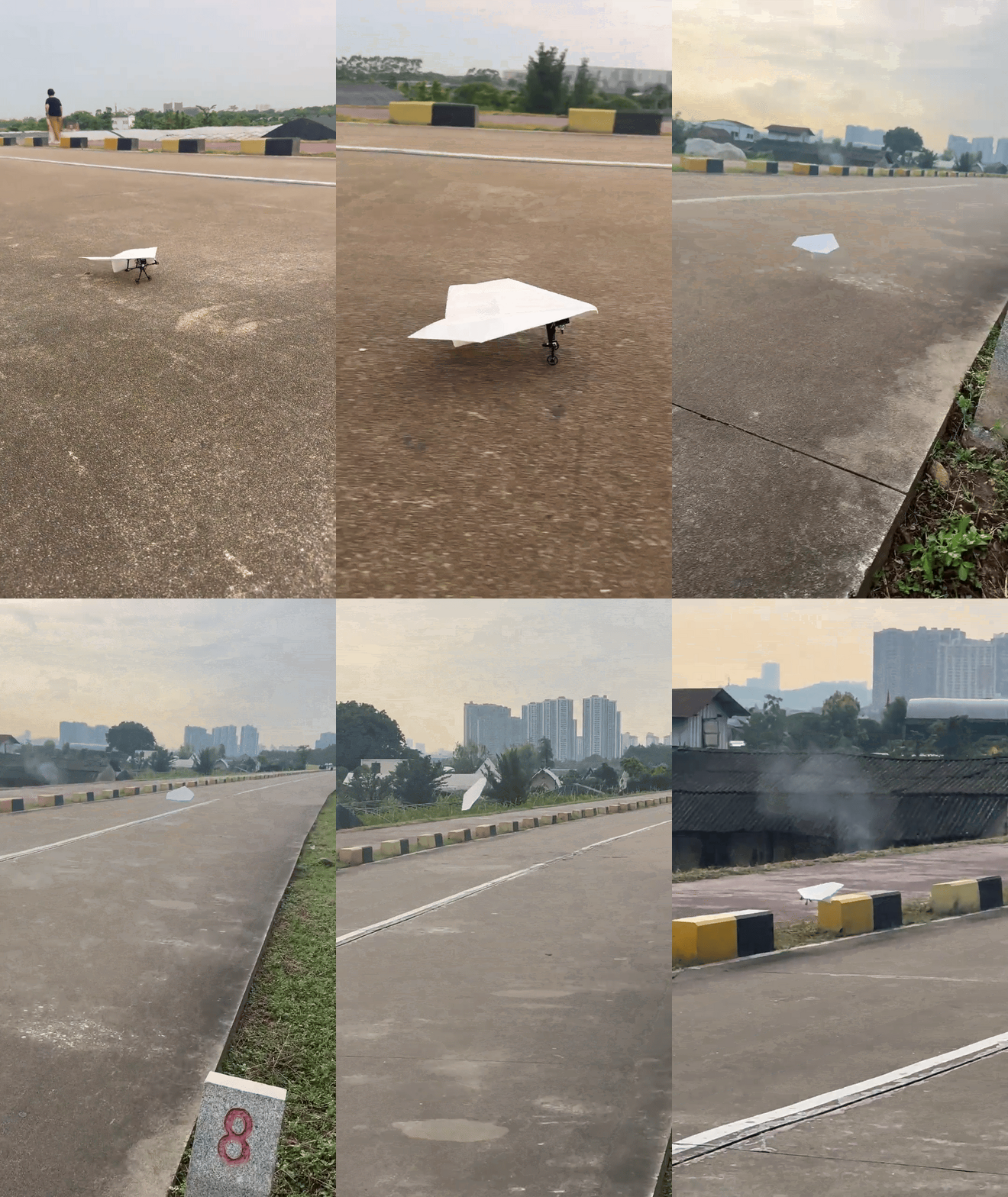
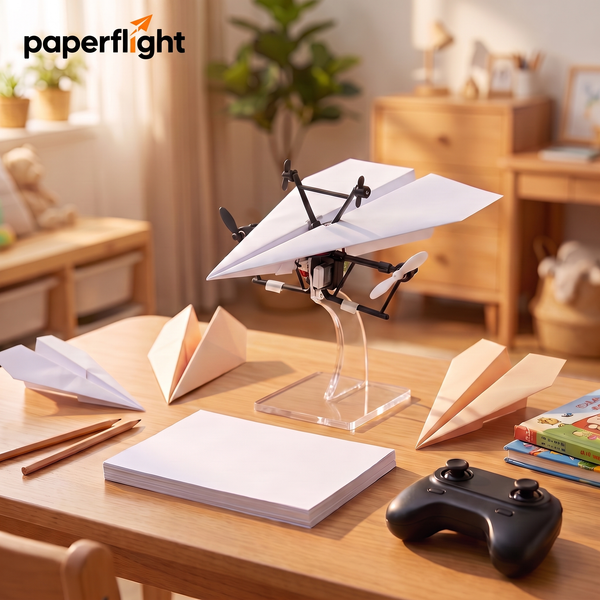
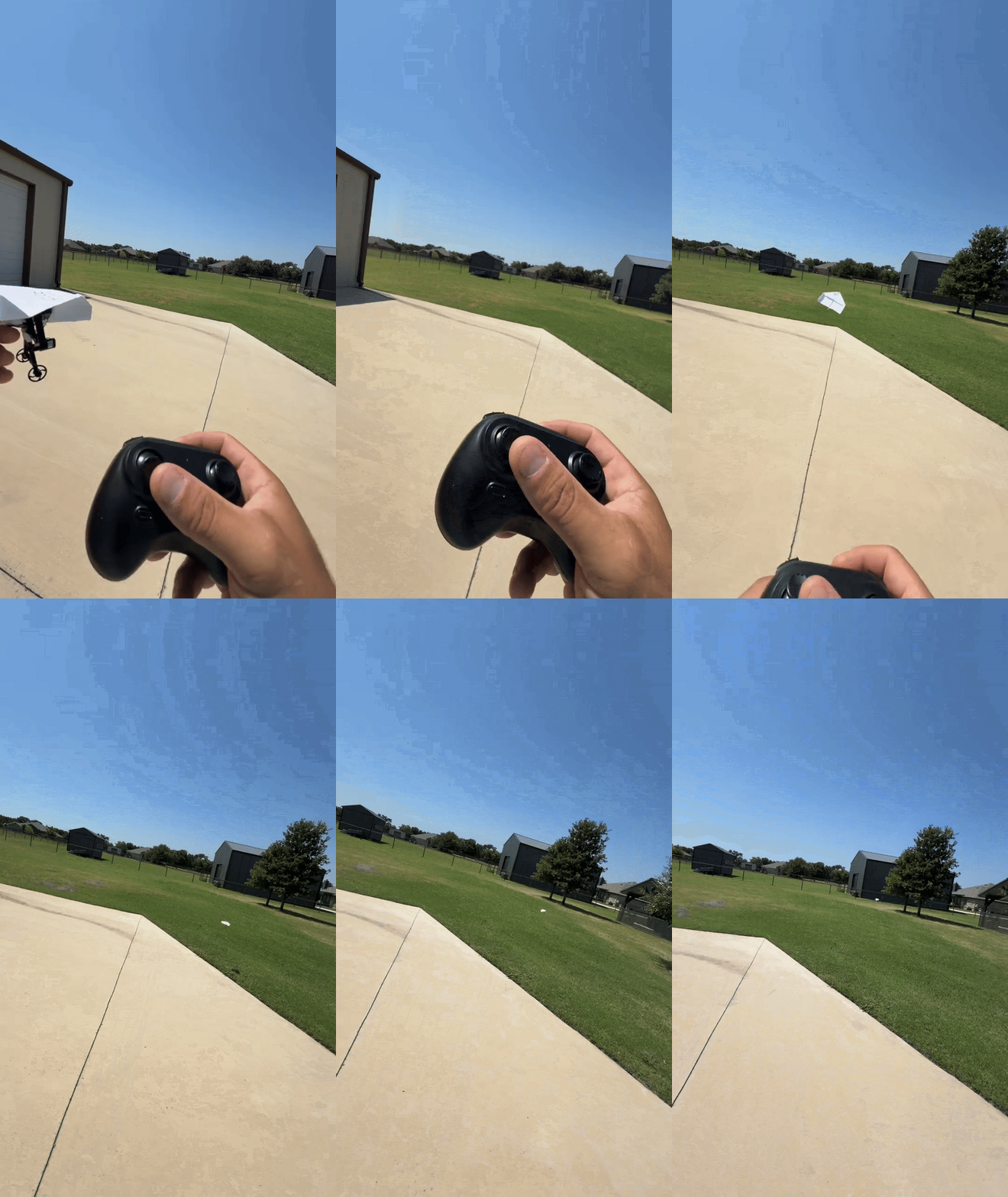
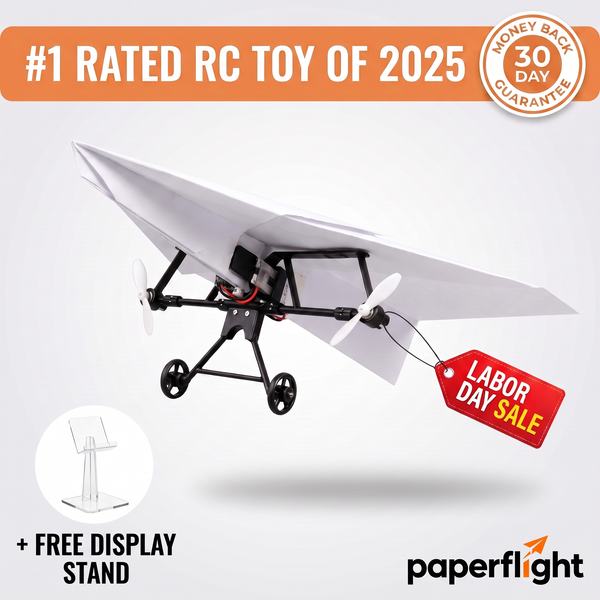
PaperFlight took the list from Reason #1 and deleted it. The airplane is a sheet of ordinary printer paper, folded at the kitchen table. The only hardware is a small black frame that clips under the nose: two propellers on a crossbar, a gyro in the middle, and a battery the size of a matchbox.
It steers without any of the parts a foam plane needs. Push the stick right and the left prop spins faster than the right one, so the plane banks right. Push left, the opposite. No servos, no ESC, no pushrods, no rudder, no elevator. The gyro holds the wings level between your inputs so it flies instead of corkscrewing.
Which means there is nothing on board that isn't either making thrust or being flown. No dead weight. The motor carries itself and five grams of paper, and the battery that would be done in minutes under foam just cruises.
About an Hour on One Charge. Then Swap in a Spare From the Box.
This is what all that physics buys you. One small battery runs PaperFlight for about an hour of flying. Not a demo flight. An hour of climbing, banking, landing in the grass, folding a new plane when the old one's had it, and going again.
When the battery finally does run down, you don't walk to the car for the charger. The box ships with spare batteries. Pull the dead one out of the frame, push the spare in, and the afternoon keeps going. They charge off any USB port, so the one you swapped out is topped up by the time you need it.
And the walk to the far corner of the field? When PaperFlight comes down, it's paper. It drops, it doesn't dig in, and the frame has survived more crashes than any foamie ever will. Walk over, fold another, fly.

$34.95 — the Whole Kit, Spares Included, and Nothing to Reorder.
Add up what a foam trainer costs to actually fly for an afternoon: the plane, then the second LiPo, then the third, the balance charger, the propeller pack, the wing you glue back on twice. Flight time there is a shopping list. PaperFlight is $34.95 during the Black Friday Sale, 60% off with free shipping, and the flight time is in the box.
In the box: the twin-prop power module with the gyro, the real two-stick remote, the rechargeable battery plus spares, USB charging cable, detachable landing gear with wheels, a small screwdriver, a display stand and the manual. The only thing you add is printer paper.
One thing the regulars ask about: we now sell a tiny 1080p camera with 1TB of storage that straps to the frame. It isn't cheap, and that's on purpose. It records a full afternoon in 1080p, holds a terabyte of flights, and weighs so little the battery barely notices it's there. Everything on this page is about weight, and a camera that costs you flight time would be a camera we wouldn't sell.
Order now and it's wrapped weeks before the December scramble. Get two for $64.95, one each so nobody's sharing a remote, and it's still less than a single foam trainer before you've bought it a battery. If it's a gift, you'll see a way to have it arrive gift-ready.
A twin-propeller power module with a gyro that clips under the nose of any paper plane you fold — flown with a real two-stick remote. About an hour of flight per charge, spare batteries in the box, and the only thing that ever breaks is a sheet of paper.

Why 60% off for Black Friday? Every kit that ships now is one we're not racing to deliver in the December crush. Black Friday shoppers get the price. When it ends, it goes back up — that's the whole story.
That's the $90 kit — the one with the app and the spare-parts packs. PaperFlight gives you the exact same moment — a plane you folded, climbing — with two real sticks in your hands, about an hour on a charge, spare batteries in the box, and nothing to reorder when it hits the ground.
$34.95 during the Black Friday Sale — 60% off, free shipping, spare batteries in the box, and 30 days to change your mind. A motor that only lifts itself, a wing that weighs five grams, and about an hour in the air every time you push the stick forward.
Get PaperFlight — 60% Off →